Global Education Policies and Their Influence on Environmental Sustainability

Cover image for: Global Education Policies and Their Influence on Environmental Sustainability

Global Education Policies and Their Influence on Environmental Sustainability

Abstract

In the face of escalating environmental challenges such as climate change, biodiversity loss, deforestation, and resource depletion, education has emerged as a crucial tool for fostering sustainability. Global education policies play a pivotal role in shaping environmental awareness, instilling sustainable practices, and influencing both individual behaviors and large-scale policy frameworks. This study explores the intersection between education policies and environmental sustainability, assessing how national and international educational frameworks contribute to sustainable development. The research examines how international organizations, governments, and educational institutions incorporate sustainability principles into curricula, teacher training, and policy structures. Key international policies such as the United Nations Sustainable Development Goal (SDG) 4.7, UNESCO�s Education for Sustainable Development (ESD), the Paris Agreement�s climate education provisions, and OECD�s guidelines on green skills provide foundational strategies for integrating sustainability into education. Additionally, national policies from developed and developing countries are analyzed to assess their effectiveness in promoting environmental responsibility among students and the general public.
From Cities to Villages A Comparative Study of Waste Management Policies

Izuchukwu Precious Obani, Zino Izu-Obani

Waste management is a critical environmental and public health issue that affects both urban and rural communities worldwide. While cities generate vast amounts of waste due to high population density and industrial activity, villages face distinct challenges related to limited infrastructure, financial constraints, and public awareness. This study presents a comparative analysis of waste management policies in urban and rural areas, evaluating their effectiveness, sustainability, and socio-economic impact. The research examines key policy frameworks, waste collection methods, recycling strategies, and technological innovations in both settings. It highlights how cities employ advanced waste treatment technologies, such as smart waste collection systems, waste-to-energy conversion, and large-scale recycling programs, whereas villages rely more on decentralized approaches like community-led waste segregation, organic composting, and informal recycling networks. Through case studies of urban centers such as New York and London and rural communities in India and Scandinavia, the study identifies best practices and areas for policy improvement. Findings suggest that while urban areas benefit from structured regulations and technological advancements, rural communities exhibit higher efficiency in waste reduction through sustainable and locally adaptable methods. However, both systems face challenges, including inadequate public participation, enforcement gaps, and financial constraints. This study underscores the importance of an integrated approach, combining urban technological advancements with rural sustainability practices, to create a hybrid waste management model that enhances efficiency, minimizes environmental impact, and promotes community engagement. It concludes with policy recommendations aimed at fostering sustainable waste management solutions applicable to both cities and villages.

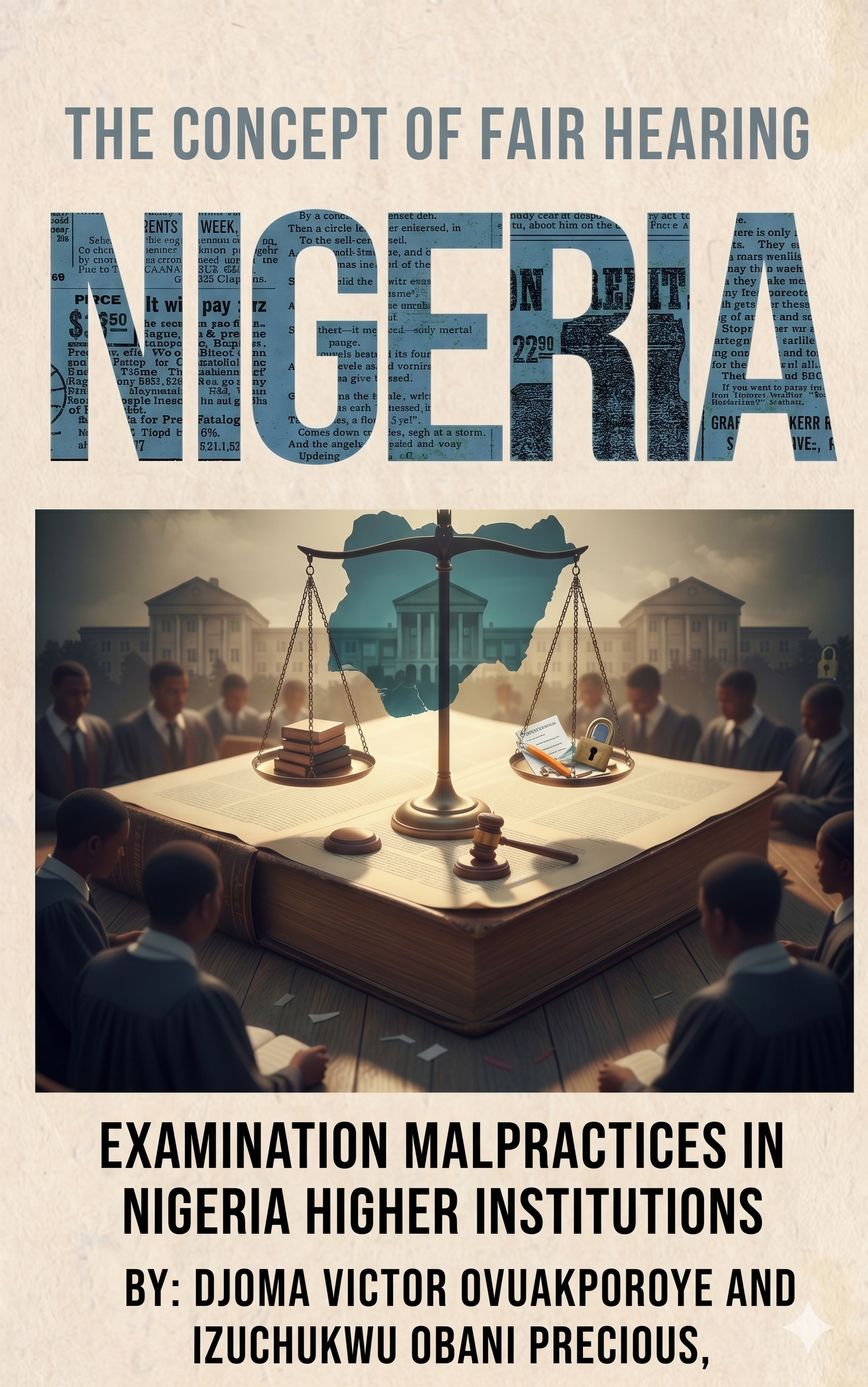
THE CONCEPT OF FAIR HEARING AND EXAMINATION MALPRACTICES IN NIGERIA HIGHER INSTITUTIONS

Djoma Victor Ovuakporoye, Obani Izuchukwu Precious

Fairness in examinations is a central ethical principle that sustains trust in educational systems and ensures that learners are assessed equitably on the basis of merit. Examination malpractices, however, undermine this principle by distorting assessment outcomes and eroding integrity in both education and society. Such malpractices include impersonation, leakage of questions, bribery, collusion, and the misuse of technology. This paper examines the concept of fairness and the persistence of examination malpractices in Nigerian tertiary institutions, with attention to their ethical, human rights, and developmental implications. The study adopts a critical analytic and descriptive method, drawing on relevant literature, policy documents, and case examples from Nigerian higher institutions to interrogate the underlying causes of examination malpractices and their impact on academic integrity. The paper finds that weak institutional frameworks, poor value orientation, inadequate supervision, and the misuse of digital technologies have deepened the problem, threatening fair assessment, promoting corruption, and undermining students’ learning outcomes. It further observes that although technological tools such as Artificial Intelligence (AI) and e-proctoring can help to curb malpractice, they require ethical deployment and human accountability. The paper concludes that fostering fairness in examinations requires a combination of value-driven education, transparent policies, accountability among stakeholders, and appropriate technological innovations. Strengthening fairness in assessment is therefore essential for building trust in educational qualifications, promoting integrity, and advancing sustainable development in contemporary society.

Public-Private Collaborations in Waste Management Evaluating Policy Effectiveness and…

Izuchukwu Precious Obani, Zino Izu Obani, Prof Frank Chudi…

Effective waste management remains a critical challenge in Nigeria, where rapid urbanization and population growth have outpaced existing waste disposal and recycling systems. Public-private collaborations (PPCs) have emerged as a viable governance model to address these inefficiencies by leveraging government policies and private sector innovations to enhance waste collection, recycling, and sustainable waste disposal. This study evaluates the effectiveness of policy frameworks and governance models guiding public-private partnerships in Nigeria�s waste management sector, examining their impact on efficiency, sustainability, and environmental protection.